
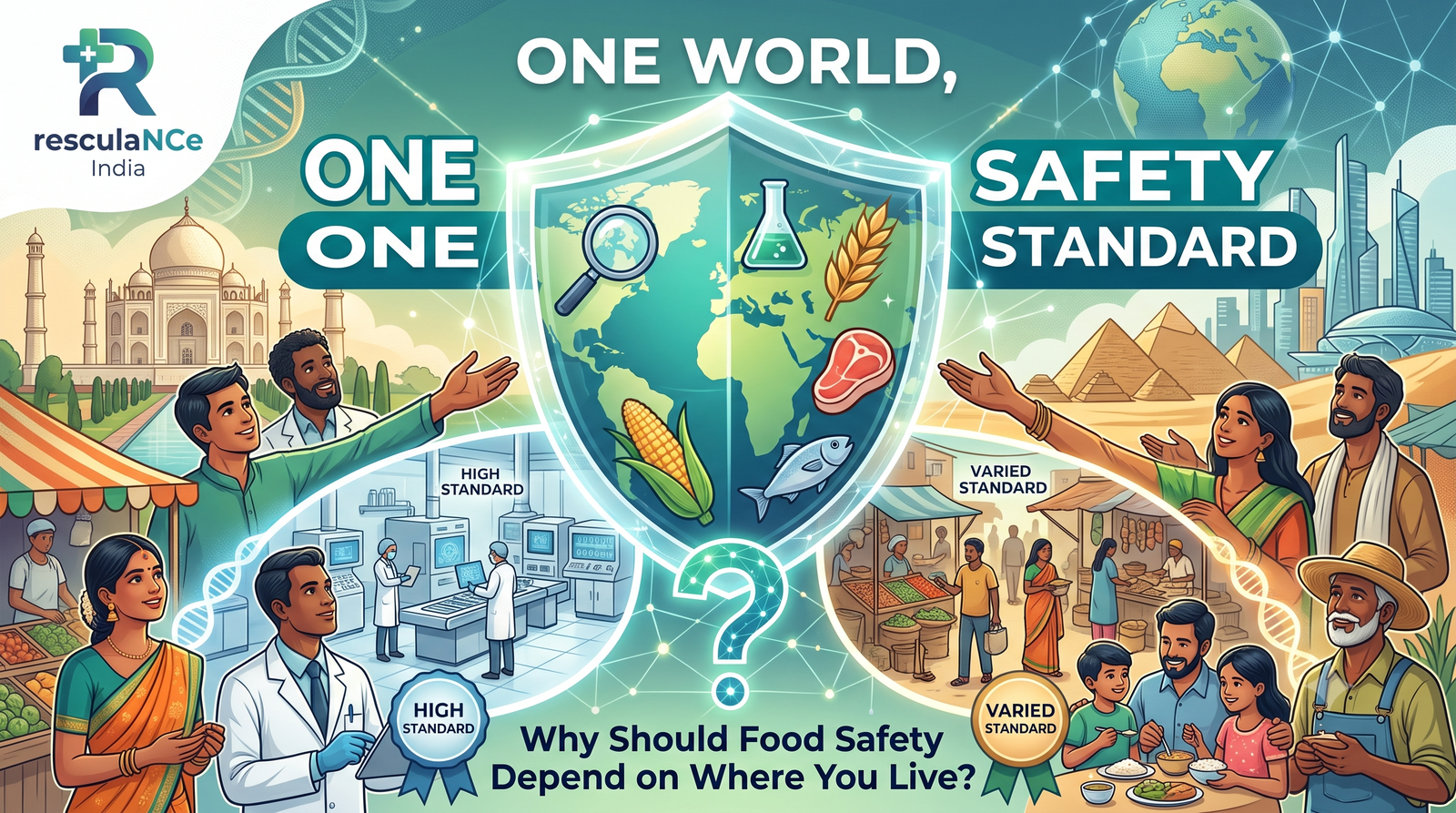
🌍 One World, One Food Safety Standard: Should Food Safety Depend on Where You Live?
Walk into a supermarket in Delhi, London, New York or Sydney and you'll find the same familiar brands lining the shelves. The same logos. The same advertisements. The same promises of quality. Yet hidden behind nearly identical packaging lies a surprising reality: the ingredients inside are not always the same.
A chocolate bar sold in Europe may follow one set of food regulations, while the same brand in another country may contain different additives, colours or preservatives. An instant noodle may carry identical branding but be manufactured with a different recipe. A soft drink may taste almost the same while complying with completely different regulatory standards. This raises a simple but powerful question:
Should the safety of our food depend on the country in which it is sold?
Around the world, food regulators work hard to protect consumers. The European Union relies heavily on the Precautionary Principle, often restricting or withdrawing additives when long-term safety cannot be fully confirmed. India's Food Safety and Standards Authority (FSSAI), the U.S. Food and Drug Administration (FDA), and other regulators conduct their own scientific assessments and may reach different conclusions. Different approaches are part of modern regulation—but should there also be a common global minimum standard?
🎨 Truth #1: The Same Candy Doesn't Always Follow the Same Rules
Bright colours attract children long before they read nutrition labels. Artificial colours such as Tartrazine (E102) and Sunset Yellow (E110) are widely used around the world. However, regulations differ.
- 🇪🇺 In the European Union, products containing certain colours generally require warnings that they may affect activity and attention in children.
- 🇮🇳 In India, these colours are permitted within prescribed limits under FSSAI regulations, but equivalent warning statements are generally not mandatory.
The question isn't simply whether these colours are allowed. The real question is: Should parents everywhere receive the same information before making choices for their children?
🧪 Truth #2: One Additive Can Have Two Very Different Regulatory Stories
Consider Titanium Dioxide (E171). For years it was used to make confectionery, chewing gum and desserts appear brighter and whiter. Following scientific review, the European Union withdrew its approval for E171 because concerns about potential genotoxicity could not be ruled out. Meanwhile, regulatory approaches in other countries have differed.
| Ingredient | European Union | India |
|---|---|---|
| Titanium Dioxide (E171) | Not authorised for food use | Permitted in specified food categories |
This illustrates how regulators can interpret scientific evidence differently. But it also raises another important question: When one major regulator changes course, how quickly should others reassess their own standards?
🍜 Truth #3: Global Brands Often Mean Local Recipes
Consumers usually expect a familiar logo to represent a familiar product. Reality is more complicated. Instant noodles, potato chips, chocolates and breakfast cereals are frequently reformulated for different countries.
- 🍜 Different spice blends.
- 🌻 Different cooking oils.
- 🧂 Different sodium levels.
- 📋 Different ingredient declarations.
- ⚖️ Different additive approvals.
Take instant noodles as an example. The recipes sold in Europe and India are not always identical. Likewise, snack foods such as potato chips may use sunflower oil in one region and palm oil in another depending on regulation, availability and manufacturing practices. The important issue isn't whether change is wrong. It's whether consumers deserve clear, transparent comparisons.
🥤 Truth #4: Even Your Favourite Soft Drink May Not Be the Same Worldwide
Soft drinks are among the most recognised consumer products on Earth. Yet multinational beverage companies frequently adjust formulations depending on the market.
- 🥤 Different sweeteners
- 🎨 Different colouring agents
- 🧪 Different preservatives
- 📊 Different nutrition labelling
- 🍬 Different sugar concentrations
These differences do not automatically indicate that one product is safer than another. However, they do demonstrate that global brands already possess the capability to manufacture region-specific recipes. Could that same capability be used to adopt a common global minimum safety benchmark?
👶 Truth #5: Children Deserve the Highest Standard Everywhere
Children consume breakfast cereals, chocolates, flavoured drinks and confectionery almost every day. If any group deserves maximum transparency, it is them. Imagine if every food package sold anywhere in the world included:
- ✅ QR code linking to scientific safety assessments
- ✅ Country-by-country ingredient comparison
- ✅ Independent laboratory reports
- ✅ Clear explanation of why formulations differ
Transparency creates trust. Silence creates suspicion.
🌍 What Could a Global Food Safety Standard Look Like?
No single regulator should control the world's food supply. But international organisations such as the WHO and Codex Alimentarius could help establish a global minimum food safety benchmark while allowing countries to adopt stricter rules where appropriate. Such a framework could include:
- 🌍 Common scientific review principles.
- 📑 Global ingredient transparency.
- 📱 QR-code based ingredient comparison.
- 🔬 Rapid international review when major regulators restrict an additive.
- 📦 Standardised front-of-pack information.
🍽️ The Bigger Question
Food companies have become global. Consumers have become global. Supply chains have become global. Perhaps it is time for minimum food safety expectations to become global as well. The goal is not to criticise one country or another. The goal is to ensure that every consumer—regardless of nationality—receives food that is produced transparently, assessed scientifically and communicated honestly.
One World.
One Consumer.
One Minimum Food Safety Standard.