5G Smart Ambulances in India: Turning Transport Time into Treatment Time
Discover how 5G smart ambulances connect patients, paramedics and hospitals through live vitals, video consultation and secure digital handovers.
CARE SHOULD BEGIN BEFORE ARRIVAL
An ambulance journey is measured in kilometres.
For the family inside it, the journey is measured in uncertainty.
Is their loved one stable? Does the hospital know what is happening? Can the medical team get specialist guidance before arrival?
These questions explain the purpose of a connected ambulance more clearly than any technology specification.
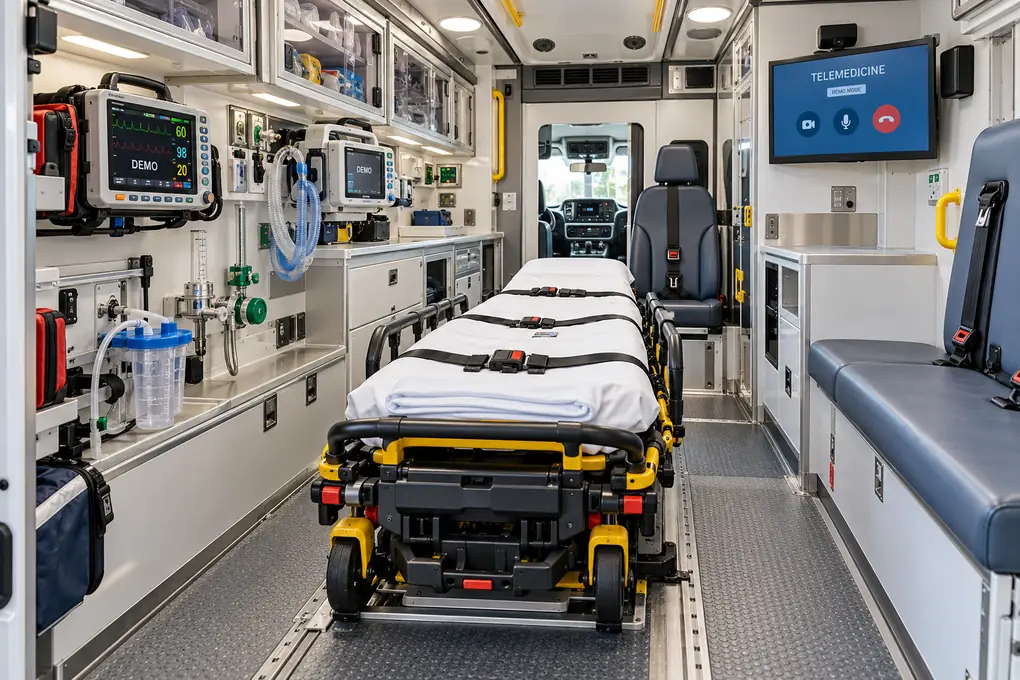
A 5G smart ambulance brings ambulance personnel and receiving healthcare teams closer through shared information, communication and coordinated preparation.
The ambition is simple:
Turn transport time into treatment time.
01 / WHAT MAKES AN AMBULANCE “SMART”?
A connected ambulance combines clinical equipment, compatible device interfaces, mobile connectivity and software that shares relevant information with authorised healthcare professionals.
Depending on the configuration, it can support:
• Patient observations from compatible medical devices.
• Two-way audio and video consultation.
• Ambulance location and estimated arrival time.
• Digital clinical notes and transfer records.
• Pre-arrival communication with the receiving hospital.
But a router alone does not create an advanced life-support ambulance.
Equipment, trained personnel, clinical protocols and medical oversight remain fundamental. Connectivity should strengthen these foundations.
WHO’s 2025 operational guidance addresses ambulance care as a complete system, covering operations, dispatch, medical oversight, clinical protocols and structured handover. [1]
The lesson: build a connected care process, not just a connected vehicle.
02 / WHAT RESEARCH TELLS US
There is evidence that ambulance-to-hospital connectivity is technically achievable. There is also a need to distinguish a successful demonstration from proven improvements in patient outcomes.
INDIA’S CONNECTED-AMBULANCE DEMONSTRATION
On 28 April 2022, Airtel, Apollo Hospitals and Cisco announced a 5G connected-ambulance demonstration in Bengaluru using allocated trial spectrum.
The demonstration brought together patient telemetry, cameras and communication with hospital teams. It illustrated how information could travel ahead of the patient. [2]
A CLOSER LOOK AT THE NUMBERS
A 2022 study in JMIR Formative Research evaluated ambulance-to-hospital transmission of ultrasound and video over a 5G test network. [3]
Reported results from that particular setup:
• Average end-to-end round-trip latency: 10 milliseconds.
• Average ultrasound-image traffic: 4 Mbps.
• Average video-stream traffic: 12 Mbps.
• Under traffic saturation: video quality and streaming performance deteriorated.
These are study-specific measurements, not guaranteed specifications for every ambulance, mobile network or journey.
The practical takeaway is important: speed matters, but congestion, coverage and system design matter too.
03 / THE RIGHT INFORMATION, AT THE RIGHT TIME
A number on a dashboard is only useful when the clinical team understands what it represents.
Which patient does it belong to?
When was it measured?
Which device supplied it?
Is it current, delayed or unavailable?
For connected-ambulance projects, we recommend displaying timestamps, units, patient or encounter identifiers and clear connection status alongside observations.
A previously received reading should not continue to appear live after communication stops. Missing data should not silently become a normal value.
Device compatibility also needs careful verification. A monitor or ventilator may require a particular interface, software option or manufacturer-supported integration before it can export useful information.
Ask for confirmation against the exact device model—not simply the equipment category.
04 / HELPING THE HOSPITAL PREPARE
Imagine an ambulance transferring a patient while its team shares observations and requests clinical guidance. Before arrival, the receiving team reviews the information and confirms the required arrangements.
This is an illustrative workflow, not a claim about a particular patient outcome.
Its value lies in continuity: the patient’s story can begin reaching the hospital before the ambulance reaches the entrance.
A useful pre-arrival handover should communicate:
• Why the patient is being transferred.
• Relevant observations and changes during the journey.
• Care already provided.
• Estimated arrival time.
• Assistance required on arrival.
Remote advice must operate within agreed protocols and the ambulance team’s authorised scope of practice.
Technology supports professional judgement. It does not replace it.
05 / THE MOST IMPORTANT TEST: WHEN CONNECTIVITY FAILS
A clear video call in a parked ambulance is a useful demonstration.
A moving-vehicle trial through weak coverage is a more demanding test.
For procurement, we recommend asking what happens when:
• The preferred mobile network becomes unavailable.
• Available bandwidth falls sharply.
• A device stops sending observations.
• Video disconnects during a consultation.
• Connectivity returns after an interruption.
Depending on the design, resilience measures may include alternative connectivity, reduced video bandwidth, local recording and safe synchronisation after reconnection.
Dual-SIM capability offers another connection option; it does not guarantee uninterrupted service.
Most importantly, essential bedside care must continue independently of the remote dashboard. Staff should understand the backup communication process and which functions remain available offline.
A dependable system makes its limitations visible.
06 / CONNECTING WITH THE HOSPITAL’S DIGITAL SYSTEMS
Information should remain useful after the ambulance journey ends.
India’s ABDM FHIR Implementation Guide, published by the National Resource Centre for EHR Standards, defines requirements for exchanging health-record information using HL7 FHIR R4. It also describes consent-based information use within the ABDM ecosystem. [4]
In practical terms, standards help different systems represent and exchange information consistently.
However, “FHIR supported” does not mean every hospital connection is ready.
Patient identifiers, clinical terminology, data fields, permissions and receiving-system requirements still need to be agreed and tested. A FHIR interface alone is not proof of completed ABDM integration.
The useful question is:
“Can you demonstrate a complete, authorised information exchange with the system our hospital actually uses?”
07 / SECURITY BELONGS IN THE CARE PLAN
Connected ambulances may handle sensitive clinical observations, recordings and location information.
The US FDA identifies cybersecurity as a shared responsibility involving medical-device manufacturers and healthcare organisations. It also recognises that cybersecurity vulnerabilities can affect device safety and effectiveness. This is an international safety reference, not evidence of Indian regulatory compliance. [5]
Our recommended procurement checklist includes:
• Individual accounts and role-based permissions.
• Encryption for sensitive information.
• Records of access and important system actions.
• Supported software updates.
• Clear recording and retention policies.
• A process for removing former staff access.
• A documented response to security incidents.
Ask who can see patient information, why they need access and how long the information is retained.
No supplier should promise absolute security. A credible partner should explain both the safeguards and the response process.
08 / SEVEN QUESTIONS BEFORE YOU BUY
When evaluating a 5G ambulance maker or smart-ambulance integration partner in India, use these questions to guide the discussion.
1. CLINICAL FIT
Does the configuration match our service, staffing and transfer requirements?
2. DEVICE COMPATIBILITY
Which exact equipment models and data fields have been tested?
3. CONNECTIVITY
How does the system behave during weak coverage and complete disconnection?
4. RESPONSIBILITY
Who receives alerts, answers consultations and acknowledges handovers?
5. DATA PROTECTION
Who controls access, recordings, retention and incident response?
6. LIFECYCLE SUPPORT
Who provides training, maintenance, updates and fault resolution?
7. ACCEPTANCE TESTING
What must work before we approve the installation?
Request a moving-vehicle demonstration, a connectivity-interruption test and an end-to-end handover exercise.
09 / MEASURE WHAT MATTERS
A dashboard can look impressive without improving the working day of an ambulance team.
Define measurable objectives before deployment.
Useful service measures include:
• Consultation connection success.
• Age of the latest received observation.
• Completeness of handover records.
• Successful pre-arrival notifications.
• System availability.
• Time taken to restore failed services.
Claims about survival or mortality require appropriately designed research. They cannot be calculated from network speed alone.
A phased pilot helps identify problems, establish a baseline and improve the workflow before expanding across a fleet.
THE RESCULANCE INDIA PERSPECTIVE
At Resculance India, “Connected to Care” expresses our purpose: helping ambulance personnel and receiving healthcare teams share a clearer understanding of the patient’s journey.
Our model families—AmbuLine, AmbuLive, AmbuLife, AmbuLike and AmbuRide—provide starting points for discussing different operational needs.
The final configuration should follow the vehicle, clinical equipment, service requirements and connectivity environment.
The first question should always be:
“What care problem are we trying to solve?”
The technology should follow the answer.
LET’S PLAN YOUR CONNECTED AMBULANCE
Upgrading an existing ambulance?
Planning a new smart-ambulance project?
Connecting a hospital with its transport fleet?
Start with a discussion about your vehicle, equipment and intended workflow.
Explore our ambulance models:
https://resculance.in/models
Discuss your requirements on WhatsApp:
https://wa.me/917303052600
Email:
connect@resculance.in
Resculance India
Connected to Care.
Because the journey to hospital should also be a journey of care.
RESEARCH SOURCES
[1] World Health Organization. Prehospital emergency care: operational guidance for ambulance systems. 2025.
https://www.who.int/publications/9789240114067
[2] Airtel. Airtel, Apollo Hospitals and Cisco demonstrate a 5G Connected Ambulance. 28 April 2022.
https://www.airtel.in/press-release/04-2022/airtel-apollo-hospitals-and-cisco-join-forces-to-demonstrate-the-future-of-healthcare-with-5g-connected-ambulance
[3] Berlet and colleagues. Emergency Telemedicine Mobile Ultrasounds Using a 5G-Enabled Application: Development and Usability Study. JMIR Formative Research. 2022.
https://pubmed.ncbi.nlm.nih.gov/35617009/
[4] National Resource Centre for EHR Standards. FHIR Implementation Guide for ABDM.
https://www.nrces.in/ndhm/fhir/r4/
[5] US Food and Drug Administration. Medical-device cybersecurity.
https://www.fda.gov/medical-devices/digital-health-center-excellence/cybersecurity
Educational and procurement information only. This article does not replace clinical protocols, professional medical judgement or project-specific technical and regulatory assessment.